


Caribbean Trade Wind Passages
500 miles. Real watches. Real confidence.
These are Caribbean trade wind sailing passages aboard s/v Libra, sailed island to island through the Eastern Caribbean island chain, day and night, with real miles, real watches, and purposeful stops along the way. This is passage sailing, not harbor hopping.
This is not a course built around books or classrooms. There are no lectures to sit through and no tests to pass. Learning happens the way it always has offshore, by doing the work underway and understanding why the boat responds the way it does.
For some, this is training. For others, it’s time away with purpose. Either way, you’re here to sail, learn, and be part of a working crew. The reward comes from steady wind, shared effort, real miles, and the quiet satisfaction of sailing over the horizon.
There is laughter aboard. There are great meals, strong on topic conversations, and memorable island stops. But the focus is always the sailing. This is not a party boat, and no one is here to be a passenger.
It’s a small crew (6 max) on a serious boat, sailing consistent trade winds, standing watches, handling sails under load, and building confidence the only way it can be built, by doing.

What These Passages Are Like
Once the anchor is weighed and the boat is settled on her course, life aboard quickly falls into a steady, organized routine shaped by wind, weather, and distance. The goal is to move efficiently through the Eastern Caribbean, making consistent progress each day while operating the boat safely and well.
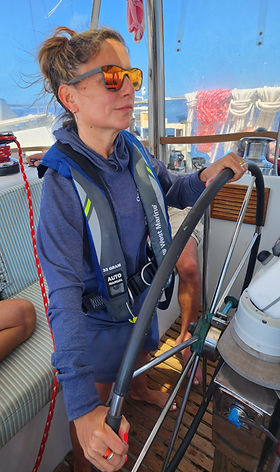
We sail on a structured watch rotation, three hours on and six hours off, standing watch in pairs so you always have a watch partner. This creates predictable rest, shared responsibility, and a calm pace aboard. Everyone stands watches, spends time on the helm, and participates in running the boat.
Sail trim, balance, and boat handling are taught in real time, with adjustments explained as they happen. You learn how the boat responds to changes in wind, sea state, and speed, and how those decisions affect comfort, efficiency, and schedule over the course of a passage.
Navigation and onboard systems are part of daily operations. Routes are discussed, instruments are used intentionally, and decisions are made to maintain good pace while balancing wind, conditions, and schedule with sound seamanship and practical judgment.
Night sailing is approached in a structured and supportive way. Watches continue on the same rotation, expectations are clear, and no one is left to figure things out alone. You learn how to manage the boat, monitor systems, and maintain situational awareness after dark in a controlled, confidence-building environment.
Over the course of a passage, the routine becomes familiar. Skills repeat, understanding deepens, and confidence builds naturally. Whether your goal is to prepare for sailing your own boat or to gain meaningful experience exploring the Caribbean aboard Libra, the focus remains the same: competent, intentional passage sailing.
This is sailing measured in days and nights, with steady progress, shared responsibility, and learning that happens underway.

Mate Brooke Carleton
On Libra passages, we sail with a dedicated mate responsible for day to day deck operations and onboard systems, keeping both the boat and crew operating smoothly while underway. Brooke manages deck ops, maintenance, provisioning, and onboard logistics, ensuring the vessel is organized, efficient, and ready for whatever the passage brings. She is also a top tier problem solver with a strong mechanical and practical skill set.
Her role supports safe watch standing, effective sail handling, and a steady onboard rhythm, allowing the crew to focus on learning, sailing, and seamanship without distraction. Brooke’s presence is a key part of how Libra runs professionally offshore and a major reason the boat functions as a cohesive, well run team at sea.
What You'll Learn
The focus of these passages is practical seamanship that carries forward. What you learn aboard Libra is meant to apply directly to other boats, other routes, and future sailing plans, whether that involves chartering, private ownership, or longer-range cruising.
Everything you do aboard is real and logged. Time underway counts toward your sailing résumé, including watchstanding, helming, navigation, and night sailing. For sailors planning to charter elsewhere or step onto their own boat with more confidence, this experience matters.
You’ll learn how to stand an effective offshore watch, including helming, lookout responsibilities, and situational awareness. Watches are structured, expectations are clear, and skills build through repetition rather than instruction by lecture.
Adjustments are explained as they’re made, connecting cause, effect, and performance underway. You’ll learn how small adjustments affect speed, comfort, and control over long periods of time. The emphasis is on understanding why the boat responds the way it does, so those decisions translate cleanly to other vessels.
Navigation is part of daily operations. You’ll work with charts, instruments, and routing decisions as they happen, learning how to balance wind, weather, distance, and schedule in a practical way that mirrors real-world passage planning.
Night sailing is treated as a core skill, not an add-on. You’ll gain experience managing watches, monitoring systems, and maintaining awareness after dark in a structured, supportive environment that builds confidence without unnecessary pressure.
You’ll also develop the less obvious skills that matter offshore and when chartering: communication, decision making, fatigue management, and working effectively as part of a small crew over multiple days.
The result is experience that holds up. Not just something you’ve read about or talked through, but time underway that prepares you to sail, charter, and make decisions with confidence on your own.


Who These Passages Are For
These passages are a good fit for sailors who want more than short hops or day sails, and who are interested in building real experience through time underway.
They’re well suited for:
-
Sailors preparing to charter larger or more complex boats
-
Future boat owners who want real experience before committing to ownership, and to make sure the lifestyle truly fits
-
Sailors who previously owned a boat but stepped away due to time, family, or work, and still want meaningful time on the water
-
Coastal sailors looking to gain confidence sailing day and night
-
Adventurous sailors who value learning through participation rather than instruction by lecture
You don’t need prior sailing experience to join. What matters most is a positive, team-oriented attitude and a willingness to participate. Everyone aboard is there for similar reasons, to sail, learn, and be part of a capable crew, and camaraderie tends to build quickly aboard Libra.
Many sailors return year after year. It’s common for alumni to sail two or three passages a year, continuing to build experience and stay connected to the rhythm of offshore sailing without owning a boat full time.
These passages are not designed for:
-
Guests looking for a luxury or party-style experience
-
People who expect an umbrella in their drink
-
Anyone expecting classroom-style instruction or a hour by hour fixed itinerary
If you’re curious, capable, and interested in learning through real sailing alongside others with the same mindset, you’ll likely feel at home aboard Libra.


How These Routes Are Designed
These passages are intentionally routed through the Eastern Caribbean island chain to balance distance, learning, and logistics. The goal is not to rush from stop to stop, but to sail meaningful legs that allow the crew to settle into passage routines while still making purposeful landfalls along the way.
Each route is planned with distance in mind. Legs are long enough to require real watchkeeping, night sailing, and sustained sail trim, but structured so that arrivals are predictable and schedules remain realistic. This allows the crew to experience true passage sailing without unnecessary pressure.
Stops are chosen for practical reasons. They provide opportunities to rest, reset, resupply, and debrief what was learned underway. They also reflect the realities of sailing the Caribbean, where planning, timing, and local conditions matter as much as distance.
Routing decisions are discussed as part of the passage. Wind angles, sea state, forecasts, and timing all factor into how and when we move. Sometimes that means adjusting plans to maintain good pace and comfort. Sometimes it means waiting. The emphasis is always on sound seamanship and good judgment.
By the end of the passage, the islands feel connected not by flights or ferry schedules, but by miles sailed. You gain a clear sense of what it actually takes to move a boat through the Caribbean under sail, one leg at a time.


How To Choose Your Passage
Not all passages are the same, even though they all follow the same seamanship-first approach. Think about what you want to get out of your time aboard:
Northbound passages - Windward to Leeward
Great for progression through the islands, multiple day sails, evolving watch routines, and a mix of island time and offshore legs.
Southbound passages - Leeward to Windward
Longer offshore legs, mixed with inter-island navigation and a few stops in the Caribbean.
Loop or varied legs - Leeward Islands
Island exploration with shorter daytime transitions and a measured introduction to overnight sailing.
Next-level offshore
For those ready to expand their offshore experience beyond the island chain only a few bunks remain for the St Martin to Bermuda 900nm Offshore run.

FAQ's
Am I too old to join a Sail Libra passage?
Age itself isn’t the deciding factor. What matters is your ability to move around the boat safely, follow instructions, and participate as part of the crew. Many Sail Libra sailors are in their 60s, 70s, and beyond. If you’re active, engaged, and interested in sailing, age is not a limitation.
Do I need prior sailing experience?
No. You don’t need any prior sailing experience to join a Sail Libra passage. What matters most is a positive, team-oriented attitude and a willingness to participate. Everyone aboard is there to sail, learn, and be part of a working crew, and camaraderie builds quickly underway.
How do watches work onboard?
We sail on a structured watch rotation of three hours on and six hours off, standing watches in pairs so you always have a watch partner. Watches include helming, lookout duties, and basic systems awareness, with clear expectations and guidance throughout the passage.
What’s included onboard?
All meals, snacks, and basic provisioning are included. Each crew member is assigned a bunk, and bedding is provided. Libra carries full safety gear, navigation equipment, and onboard systems needed for offshore passage sailing. A dedicated mate manages much of the day-to-day onboard operation so the crew can focus on sailing and learning not cooking and provisioning.
Does this time count toward chartering or sailing experience?
Yes. Time aboard Libra is real time underway and counts toward your sailing résumé. Many sailors use this experience when preparing to charter elsewhere, plan future trips, or step into ownership with greater confidence.
Have more questions?
You’ll find detailed answers covering packing, seasickness, connectivity, dietary needs, and logistics on our full FAQ page.


The Next Step
If this kind of sailing makes sense to you, the next step is simple. Choose the passage that fits your schedule and goals, review the details, and reach out if you have questions.
Sail Libra is a small, family-owned operation, run directly by Ryan Rayfield, the owner and captain of s/v Libra. Ryan is aboard for every passage. There’s no sales team, no handoff, and no guesswork about who you’re sailing with. What you see here is exactly how the program operates.
Libra is a U.S.-flagged vessel operated under strict U.S. Coast Guard regulations, with professional standards for safety, training, and crew management. This is a working offshore boat, run deliberately and conservatively, with a focus on real seamanship and real experience.
Each passage page includes dates, route information, logistics, and availability. If you’re unsure which trip is the best fit, a short conversation is often enough to point you in the right direction. You’re welcome to reach out directly. Quick questions are best handled by text, and Ryan is happy to respond anytime.
Sail Libra passages are designed for people who want real experience, clear structure, and time underway that actually counts. If that’s what you’re looking for, you’ll likely find your bunk waiting aboard.
→ Learn More About Ryan Rayfield
→ Text Ryan for a Quick Question at +1-251-923-8825
